Collected here are the ePortfolios from students in the Nursing Program of the School of Health Sciences at University of the Pacific.
-
Enhancing Pediatric Sun Safety: A Parent-Focused Intervention in El Dorado County
Ashley Riley, Calvin Nauer, and Alaina Godwin
Background:
Childhood ultraviolet (UV) exposure is the most significant modifiable risk factor for skin cancer, yet proper sun protection remains inconsistently practiced by parents. In El Dorado County, California, where high altitude and intense sun exposure amplify UV risk, knowledge gaps and misinformation persist despite resource availability. This quality improvement (QI) project aimed to strengthen parental knowledge, confidence, and modeling of sun-safe behaviors for their children through an evidence-based community education program.
Aim:
The goal of this QI initiative was to improve parental attitudes, self-efficacy, and photoprotective behaviors by implementing a three-part, nursing-led educational intervention focused on UV risk awareness, myth correction, and modeling of sunscreen application.Methods:
Using the Johns Hopkins Nursing Evidence-Based Practice (JHNEBP) Model, the “Sun Smart Families” program was conducted at Steve Wallen Swim School with 32 parents of children aged 3–8. Over four weeks, participants attended three interactive sessions addressing UV risks, sunscreen myths, and parental role modeling. Pre- and post-intervention surveys adapted from the Environmental Protection Agency (EPA) SunWise Program and O’Riordan et al. (2003) measured changes in knowledge and behaviors. Data were analyzed using Mann-Whitney and chi-square tests.Results:
Participants demonstrated a statistically significant increase in composite Likert-scale scores for sun-safe attitudes and behaviors (M = 25.4 to 40.6, p = .039). Five of ten survey items improved significantly, with one knowledge item (correct sunscreen volume) showing marked post-intervention gains (χ² (1) = 8.47, p = .0036). Parents reported greater confidence and intent to model photoprotective behaviors.Conclusions:
Brief, community-based education improved parental self-efficacy and sun safety attitudes, aligning with Healthy People 2030 objectives to reduce childhood sunburns. The project demonstrates a sustainable, scalable model for integrating nursing-led prevention into community recreation settings. -
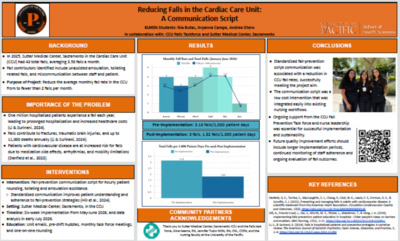
Fall Prevention in the Lobby of the Emergency Department at Sutter Medical Center Sacramento
Tanya Rodriguez Duarte, Vaneza Espino, Roshni Hayer, and Yajari Mendoza
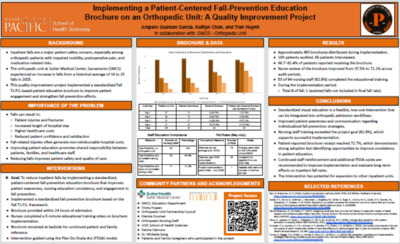
Background: In 2024, Sutter Medical Center Sacramento (SMCS) reported 17 patient falls in the Emergency Department (ED) lobby, with 94% (n = 16) occurring in the triage area. Patients awaiting placement after triage are not classified as admitted and thus are not included in CMS’s inpatient fall reporting program. However, due to the known safety risk, SMCS ED leadership began tracking lobby falls locally and partnered with University of the Pacific nursing students to address this issue.. Aim: This quality improvement project aimed to reduce the incidence of falls in the ED lobby through enhanced fall risk identification, timely reassessment, and improved patient education. The project aligned with Sutter’s mission to prioritize safety and minimize preventable harm. Methods: The quality improvement project was conducted in the ED lobby at SMCS. Patients were screened at triage using the Hester Davis Scale, and those deemed high-risk received a yellow fall risk bracelet and bilingual educational pamphlets developed and validated using the Patient Education Materials Assessment Tool (PEMAT). The intervention included: (1) targeted staff education delivered during ED shift huddles, (2) continuous reassessment of fall risk every two hours, and (3) the use of visual reminders to prompt patient safety behaviors. University of the Pacific nursing students monitored implementation through distribution logs and informal observations. Results: In 2025, four falls were reported in the lobby, occurring in February, March, April, and September. Three of these incidents occurred earlier in the year, and one occurred later. Year-to-date shows 29 total falls, with lobby falls accounting for 14% of the total, down from 17 in 2024. Conclusion: The project reinforced the importance of reassessing fall risk in not formally admitted ED patients. Interdisciplinary collaboration contributed to improvements in lobby safety practices and highlighted opportunities for future system-level interventions. Local tracking of lobby falls, although not mandated by CMS, provided valuable data to inform safety efforts.
-
Addressing Nursing Student Burnout through Mindfulness and Zen Den at University of the Pacific
Jeremy Seaton, Tanairi Ingram, and Natalia Zelayandia
Background:
Burnout among nursing students is a critical issue that negatively impacts academic performance, mental well-being, and long-term professional retention. Entry-Level Master of Science in Nursing students at University of the Pacific experience heightened stress due to rigorous coursework, clinical demands, and underdeveloped institutional mental health support.
Aim:
This Quality Improvement project aimed to reduce stress and strengthen emotional resilience among nursing students through Mindfulness-Based Stress Reduction education and the creation of a peer-supported wellness space, the “Zen Den.”
Methods:
A pre- and post-intervention design was implemented, utilizing surveys to measure mindfulness knowledge, attitudes toward self-care, and stress awareness. Zen Den utilization was tracked weekly through QR codes to assess engagement with the wellness space.
Results:
Post-intervention findings demonstrated a 5% increase in mindfulness knowledge, with Likert scale scores showing improved attitudes toward stress management and self-care (pre-intervention M = 3.56; post-intervention M = 4.38). Qualitative feedback emphasized the value of accessible wellness spaces and mindfulness practices as effective coping strategies during program demands.
Conclusions:
Integrating structured mindfulness education and wellness resources into nursing curricula provides a sustainable, low-cost strategy to address student burnout. These interventions successfully increased confidence in self-awareness, emotional resilience, and ability to cope. Long term these outcomes can support academic success and long-term professional retention.
-
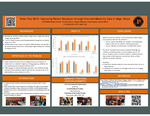
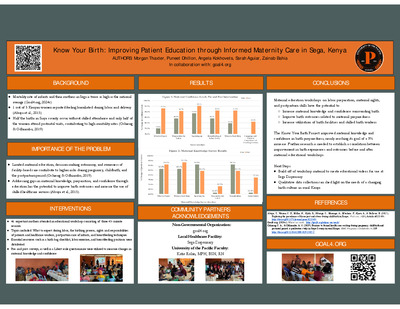
Know Your Birth: Improving Patient Education through Informed Maternity Care in Sega, Kenya
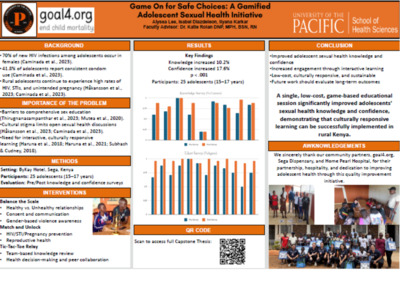
Morgan Thaxter, Puneet Dhillon, Angela Kokhovets, Sarah Aguiar, and Zainab Bahia
-
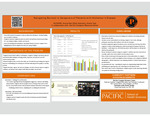
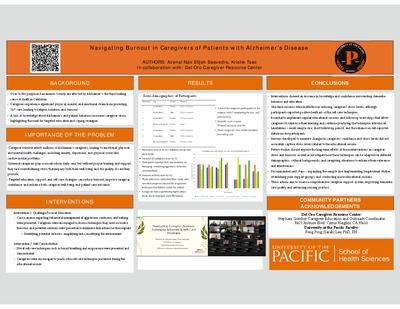
Navigating Burnout in Caregivers of Patients with Alzheimer’s Disease
Kristie Tsao, Avenal Nair, and Elijah Saavedra
-
The Kangaroo Care Project: Implementation of Skin-to-Skin (STS) in Sutter Medical Center, Sacramento, Neonatal Intensive Care Unit
Bianca Wong, Katherine Do, Martha Calero, and Lydia Nambala
Background: Skin-to-skin contact, also known as kangaroo care or kangaroo mother care, is an intervention typically done after birth to promote physiologic stability, bonding, and breastfeeding.
Aim: The Kangaroo Care project aimed to increase the incidence of skin-to-skin contact in the neonatal intensive care unit at Sutter Medical Center, Sacramento.
Methods: A pre-survey was conducted to assess staff comfort with skin to skin. Interventions to increase skin-to-skin rates included staff e-learning, unplanned extubation mock codes, nurse champions, and a policy change to Sutter Medical Center, Sacramento’s handbook.
Results: TBD. Preliminary results indicated use of STS in the NICU and post-results from the nurses’ survey are pending.
Conclusion: Increasing skin-to-skin care rates in the Sutter Medical Center Sacramento neonatal intensive care unit addressed critical barriers such as staffing shortages, limited space, and equipment availability. By enhancing staff support, education, and training, the NICU fostered greater parental involvement, which is essential for improving outcomes in preterm and low-birth-weight infants. This initiative promoted safer, more effective neonatal care, supported infant growth and development, and strengthened family-centered practices within Sacramento’s diverse community, ultimately contributing to better short- and long-term health outcomes.
-

Fit & Fueled For Two Project: Nutrition and Exercise Education for Pregnant Women in Placer County
Nadine Abed, Salma Elnaggar, Chelsea Enriquez, and Ariana Gutierrez
-
Care Beyond Incarceration: Grassroots Support for Community Reentry Success
Chelsea Bigelow, Rachel Bovenizer, and Jessica Lebedeff
-
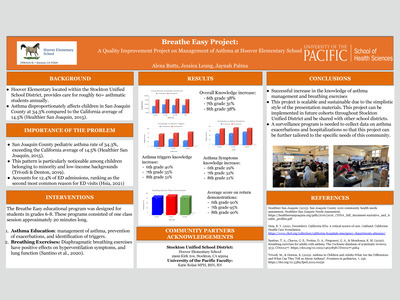
Breathe Easy Project: A Quality Improvement Project on Management of Asthma at Hoover Elementary School
Alex Butts, Jessica Leung, and Jaynah Palma
-
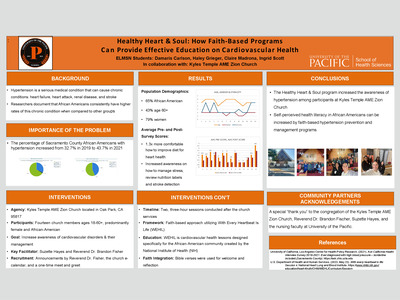
Healthy Heart and Soul: A Qualitative Report on How Faith-Based Programs Can Provide Effective Education on Cardiovascular Health
Damaris Carlson, Haley Grieger, Claire Madrona, and Ingrid Scott
-
Empowering Community Health Promoters for Healthy Births in Sega, Kenya
Melissa Castro, Trang Ha, Dominique Tagupa, and Kaliah Vang
-
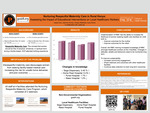
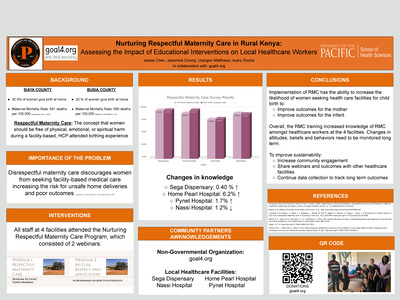
Nurturing Respectful Maternity Care in Rural Kenya: Assessing the Impact of Educational Interventions on Local Healthcare Workers
Jessie Chen, Jassmine Duong, Urangoo Matthews, and Avery Rocha
-
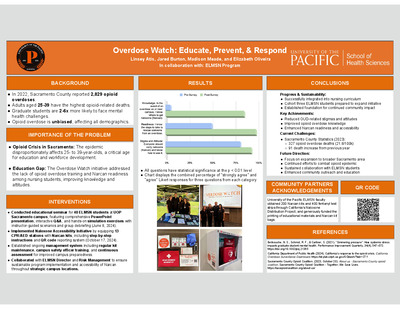
Overdose Watch: Educate, Prevent, and Respond…Equitably
Amber Childress, Christine Nava, and Genevie Porlaris
-
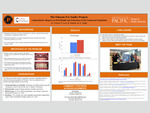
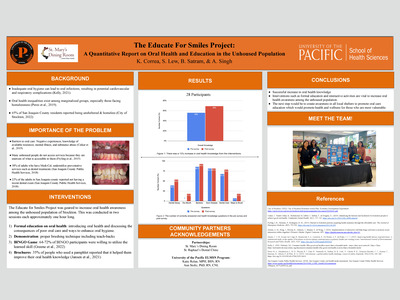
Say Yes to Oral Care! A Quantitative Report on Oral Health and Education in the Unhoused Population
Kiana Correa, Sharon Lew, Brianna Satram, and Ashika Singh
-
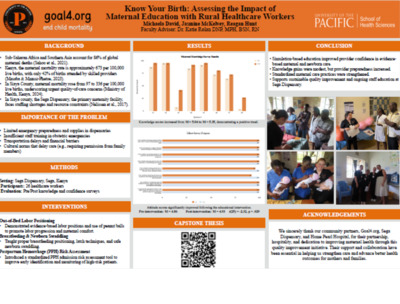
Know Your Birth: Improving Knowledge and Confidence through Education on Childbirth in Rural Kenya
Stephanie Cortez, Jasmine Ochoa, Manvi Pal, and Carol Xiong
-
Promoting Mental Health for Graduate Students: The Mind Matters Initiative
Kelly Donahoe, Marissa Marchman, Anna Ramos, and Silvia Reyes
-
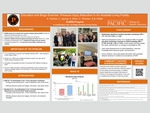
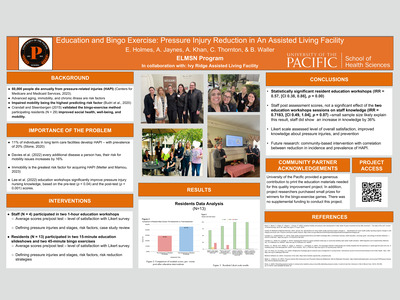
Education and Bingo Exercise: Pressure Injury Reduction in an Assisted Living Facility
Emmalee Holmes, Ashley Jaynes, Annah Khan, Caitlin Thornton, and Brooke Waller
-
Enhancing Wellbeing in the Assisted Living Setting: Musical Memories and Pill Prep
Kinsey Hopkins, Audrey Maskiewicz, Ashley Nguyen, and Kailynne Van Winkle
-
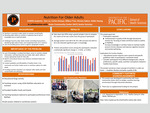
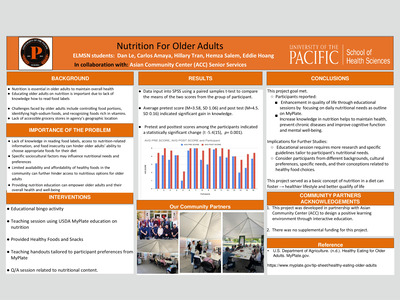
Nutrition Education for Older Adults
Dan Le, Eddie Hoang, Hillary Tran, Hemza Salem, and Carlos Amaya
-
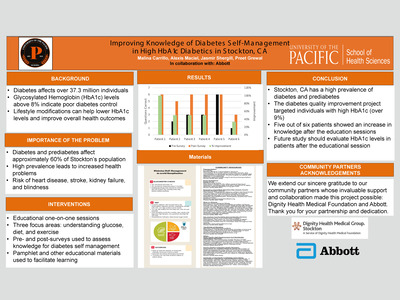
Improving Knowledge of Diabetes Self-Management in High HbA1c Diabetic Adults in Stockton, California
Alexis M. Maciel, Preet K. Grewal, Malina M. Carrillo, and Jasmir A. Shergill
-
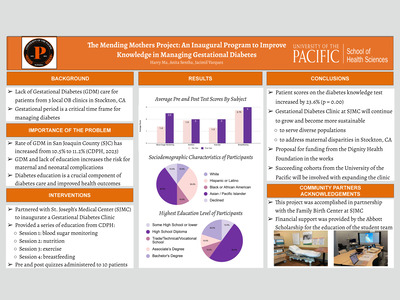
The Mending Mothers Project: An Inaugural Program to Improve Knowledge in Managing Gestational Diabetes
Harry Ma, Anita Sentha, and Jacimil Varquez
-
The Fields of Care Project: Diabetes Education for Agricultural Laborers of Stockton, California
Matthew Medel, Juan Fernando Rosero, Valerie Visochin, and Antonella Winer
-
Eat to ‘Beet’ Disease Through Improving Nutrition Literacy to Empower Citizens of Oak Park, CA
Lillian Messer, Erin Skowron, Isabelle Tankka, and Geth Wu
-
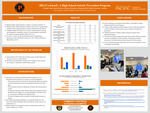
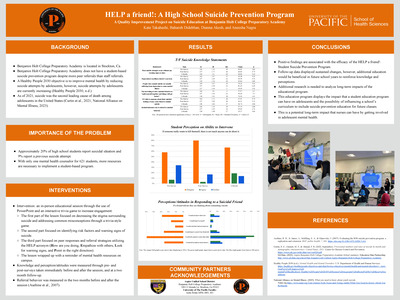
HELP a friend!: Suicide Education Program
Aneesha Nagra, Bahareh Didehban, Dianna Akesh, and Kate Takahashi
-
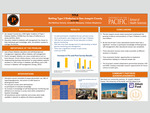
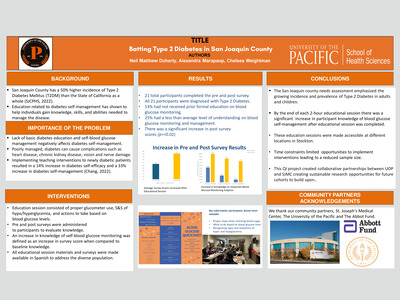
Improving Diabetic Patient’s Self-Management knowledge through Educational Sessions on Blood Glucose Monitoring
Chelsea Weightman, Alexandra Marapao, and Matthew Doherty