

Files
Download Full Text (6.8 MB)
Document Type
Dissertation
Description
Scholarly communication is a complex socio-technical information system where human actors and evolving digital technologies interact to advance knowledge creation, validation, and the sharing of information. While academic libraries have long been a core component, they have shifted from passive repositories to active service providers within the information system space in response to profound disruptions. The persistent uncertainty facing libraries challenges traditional knowledge creation practices, historically rooted in managing physical artifacts, and presents new opportunities for innovation centered on networked information access and human-focused digital service design.
This dissertation investigates the evolving role of scholarly communications services amidst systemic disruptions like the COVID-19 pandemic and the rise of generative AI. The research is understood as both a study of disruption and a study conducted through disruption. The central research question is: How does value co-creation shape scholarly communication as a socio-technical system across diverse contexts and amidst systemic disruptions? Grounded in socio-technical Information Systems theory and using Service-Dominant Logic as its primary analytical framework, this dissertation employs a retrospective metanarrative of engaged scholarship, synthesizing findings from five empirical studies (2018 and 2025).
The findings demonstrate an organizational shift from a static content pipeline to a dynamic service platform, where participants are repositioned from passive consumers to active co-creating partners. Value emerges not from a delivered product, but from interactive processes (e.g., participatory design, critical pedagogy) that generate tangible benefits. Results reveal that in an era of perpetual crisis, resilience and relevance are not generated from technology alone, but also from designing and nurturing human-centered co-creation.
The dissertation’s primary contribution is an empirically grounded framework for understanding scholarly communication as a value cocreation ecosystem. This approach provides a process-based view, blending the Delone & McLean Information Systems Success model to explicitly incorporate value co-creation, and deepening the socio-technical perspective. Findings yield an actionable recommendation to design for participation, not just access. The research concludes that in an age of artificial intelligence and systemic uncertainty, our most valuable and resilient infrastructure is human connection.
ISBN
9789180823999
Publication Date
1-9-2026
Publisher
Linnaeus University Press
City
Växjö, Sweden
First Page
1
Last Page
109
Keywords
Socio-Technical Systems; Value Co-Creation; Service- Dominant Logic (S-D Logic); Engaged Scholarship; Scholarly Communication; Academic Libraries
Disciplines
Library and Information Science | Scholarly Communication | Scholarly Publishing
Recommended Citation
Gibney, M.
(2026).
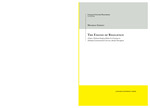
The Engine of Resilience: A Socio-Technical Study of Value Co-Creation in Scholarly Communication Services Amidst Disruption.
Växjö, Sweden: Linnaeus University Press
https://scholarlycommons.pacific.edu/libraries-books/36

Comments
Originally published in Linnaeus University's repository, DiVA: https://urn.kb.se/resolve?urn=urn%3Anbn%3Ase%3Alnu%3Adiva-143434